When planning a trip to Japan, one question comes up again and again: “How cashless is Japan, really?”
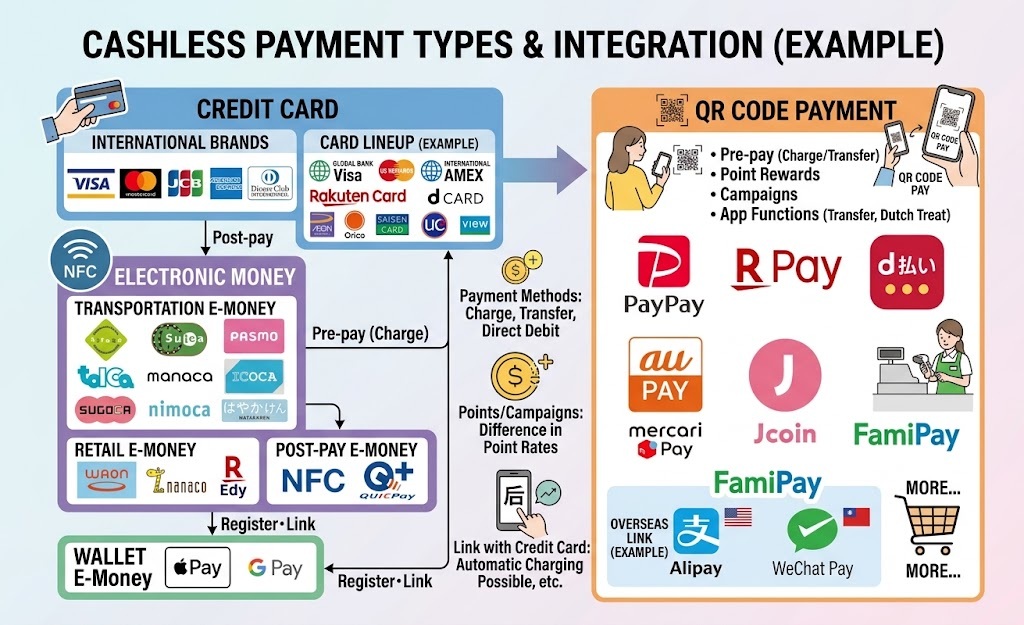
You may have heard the classic joke: “Japan has high-tech robots, bullet trains, and futuristic toilets… but do I still need cash to pay for everything?” 😂
The good news is that Japan has been moving rapidly toward a cashless society. While cash is still important in some situations, credit cards, contactless payments, IC cards, and QR payments are now widely used.
In this guide, we'll break down which payment method to use, where to use it, and what you should prepare before your trip—so you can spend less time worrying about money and more time enjoying Japan!
1. Credit Cards: Your Go-To Payment Method
Credit cards are now accepted at most hotels, department stores, restaurants, major chain stores, supermarkets, and convenience stores across Japan.
For most international visitors, your credit card will be your main payment method for larger purchases and everyday spending.
Which Card Networks Are Accepted?
Visa and Mastercard have some of the widest acceptance across Japan.
American Express and JCB are also accepted at many businesses, particularly at major hotels, department stores, and larger retailers.
A Quick Note About Tap-to-Pay
Contactless payments are becoming increasingly common in Japan, especially at major chains and newer payment terminals.
However, don't be surprised if tap-to-pay doesn't work at a particular shop.
Some stores—and especially some older payment terminals—may require you to insert your card and enter your PIN instead.
Before your trip, make sure you know your card's PIN.
And if you tap your card and nothing happens, don't panic! 😆
Just insert the card and try again.
Can You Use Overseas-Issued Cards?
Most of the time, yes—but there can be exceptions.
Some online payment systems and small independent businesses may occasionally reject overseas-issued cards.
That's why it's smart to have a backup payment method with you, whether that's another card, an IC card, or good old-fashioned cash.
Because when all else fails, Japanese yen cash is still the ultimate backup. 😉
2. IC Cards: The Easiest Way to Get Around Japan
Japan's railway system can feel like a giant puzzle when you're seeing it for the first time.
Buying a ticket every time you ride can quickly become exhausting—but with an IC card such as Suica or PASMO, getting through the ticket gates is incredibly easy.
Just tap your phone or IC card on the reader, and you're through.
And IC cards aren't just for trains.
You can also use them at convenience stores, vending machines, shops inside train stations, and some restaurants.
It's one of those little things that makes traveling around Japan feel incredibly smooth.
Before You Fly: Set Up Your IC Card
iPhone Users: Digital Suica
If you're using an iPhone, you can add a Suica or PASMO directly to Apple Wallet before your trip.
Top it up with your credit card before you leave, and you can potentially step off the plane and head straight onto a Japanese train.
How convenient is that?
Tip: Mastercard and American Express cards can work smoothly for Suica top-ups, while some overseas-issued Visa cards may have trouble when adding money to Suica through Apple Wallet. If your card doesn't work, try another card or top up with cash at a ticket machine in Japan.
Android Users & Physical Card Fans: Welcome Suica
If you'd rather use a physical IC card, international visitors can purchase Welcome Suica at major airports such as Haneda and Narita.
There is no deposit, and the card can be used for up to 28 days.
And let's be honest—the cute Suica penguin design makes a pretty great Japan souvenir, too! 🐧
3. QR Payments: Your Secret Weapon at Local Spots
When it comes to QR payments in Japan, PayPay is one of the biggest names you'll see.
You may come across small izakaya tucked away on a side street, local food spots, stalls, or businesses in regional tourist destinations where credit cards aren't accepted—but PayPay is.
That can make QR payments surprisingly useful when you're exploring beyond the big tourist areas.
Can International Visitors Use PayPay?
This is where things get a little complicated.
The standard PayPay app generally requires a Japanese mobile phone number and/or Japanese financial setup, making it difficult for most short-term international visitors to register and use it directly.
Check Your Home-Country Payment Apps
Depending on where you're from, your existing payment app may already work with PayPay's merchant network.
For example, certain services such as AlipayHK or Kakao Pay may allow eligible users to scan and pay at participating PayPay merchants in Japan.
Before your trip, check whether your usual payment app supports payments in Japan.
It's one less thing to worry about once you arrive.
What About Multi-Currency Cards?
Multi-currency cards such as Revolut can also be very convenient in Japan.
They can generally be used anywhere international cards are accepted, including many shops, restaurants, and ATMs.
For travelers who want to avoid carrying large amounts of cash, having a multi-currency card as part of your payment setup can be a convenient option.
The Golden Rule for Paying in Japan
To keep your trip smooth and avoid awkward payment surprises, here's a simple setup that works well for many international visitors:
💳 Everyday & Major Purchases
Credit cards — Visa / Mastercard / American Express / etc.
🚆 Trains, Convenience Stores & Vending Machines
Digital Suica or Welcome Suica
🍜 Local Spots & Backup
A small amount of Japanese yen in cash
Even though Japan has become much more cashless, there are still plenty of situations where cash is king.
You may encounter cash-only payment at small independent izakaya, admission counters at historic temples and shrines, some local buses, and certain coin lockers.
For peace of mind, we recommend keeping around ¥20,000–¥30,000 in cash on hand during your trip.
You can easily withdraw Japanese yen from an ATM at the airport after you arrive.
Because let's be honest: one of the greatest travel tragedies would be finding an amazing-looking ramen shop… only to discover that it's cash only. 🍜😭
With a little preparation before you fly, paying for things in Japan can be surprisingly easy.
Set up your cards, get your IC card ready, keep a little cash in your wallet—and then you're free to focus on the important stuff:
eating amazing food, exploring hidden corners of Japan, and making memories you'll want to bring home. 🇯🇵✨